
Accounting for Transport, Trucking & Logistics Businesses
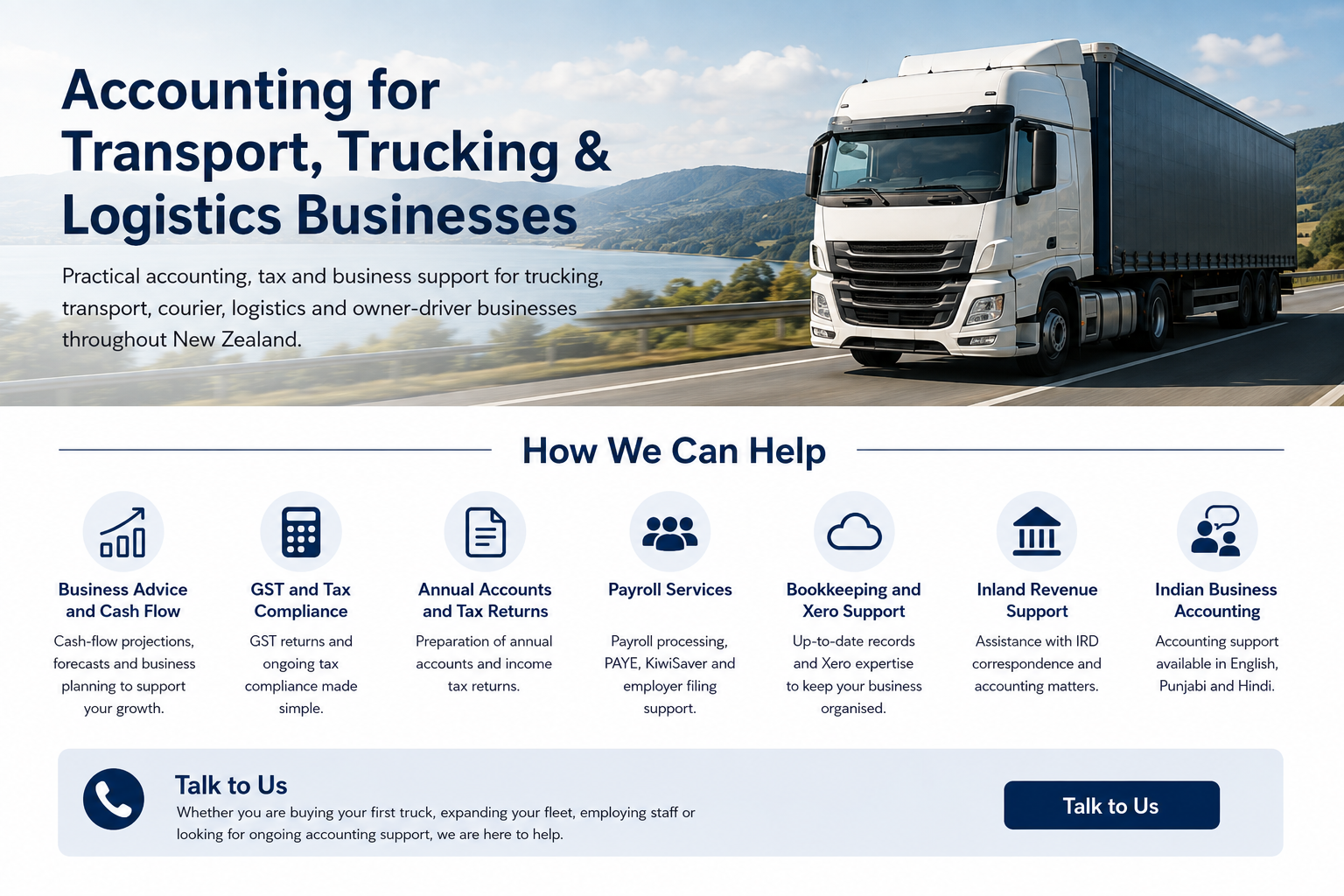
Practical accounting, tax and business support for trucking companies, owner-drivers, courier operators and logistics businesses throughout New Zealand.
-
Annual accounts, income tax returns and ongoing tax compliance.
-
GST returns, bookkeeping and Xero support to help keep your records organised.
-
Payroll accounting, PAYE and payday filing support where included in our engagement.
-
Accounting support for vehicle purchases, finance arrangements, operating costs and business cash flow.
Who We Help
Trucking Companies
Owner-Drivers
Courier & Delivery Businesses
Freight Operators
Logistics Businesses
Transport Contractors
We support businesses throughout New Zealand. Our services are not limited to any particular business size, background or transport model.
Starting, Buying or Expanding a Transport Business
If you are planning to buy your first truck or add more trucks to your fleet, it can be useful to talk to us before making the financial commitment.
Our Business Advice and Cash Flow support can include cash-flow projections, financial forecasts, business plans, management accounts, expected operating costs and financial information that may be requested by banks or other lenders.
We can also help you understand how a proposed purchase or expansion may affect the financial commitments of the business.
We do not provide any assurance or guarantee that finance will be approved. Lending decisions are made by the relevant bank or lender.
Ongoing Accounting and Business Support
As your transport business grows, keeping your accounting records current can make it easier to understand how the business is performing.
Our Bookkeeping and Xero Support can help keep your day-to-day accounting records organised and up to date.
We can also assist with GST and Tax Compliance, including GST returns, provisional tax information and other ongoing tax obligations.
At the end of the financial year, we can prepare your Annual Accounts and Tax Returns based on the information and records provided to us.
Where appropriate, we can also provide Inland Revenue Support with accounting information, correspondence and tax-related matters.
Where your records allow, we can help you review profitability by truck, contract, route or other business activity.
Trucks, Vehicles and Operating Costs
Trucks, trailers and other equipment are often major investments for a transport business.
We can assist with the accounting treatment of truck and trailer purchases, replacement vehicles, business equipment, finance and hire-purchase arrangements, asset disposals and depreciation.
Transport businesses can also have significant operating costs, including fuel, road user charges, repairs, tyres, registration, insurance, driver wages, subcontractors, yard costs and administration expenses.
Keeping these records organised can help you understand the cost of operating your vehicles and the overall financial performance of the business.
Contact Us
Tell us briefly how we can help, and we’ll get back to you.
How We Work
-
Tell us about your transport business, your current accounting arrangements and the support you are looking for.
-
We discuss the accounting records, information and access that may be required for the work.
-
We agree the scope of the engagement and any further information or authority required before the work proceeds.
Investment Boost and New Asset Purchases
If you are planning to purchase a new truck, trailer, machinery or other business asset, it may be useful to talk to us before completing the purchase.
As at 9 August 2026, New Zealand’s Investment Boost rules are still available. For qualifying assets, businesses can generally claim a 20% first-year Investment Boost deduction, with normal depreciation continuing on the remaining 80% of the asset value.
The rules may also apply to certain assets that are new to New Zealand, including some previously used overseas assets, provided the relevant eligibility requirements are met.
We can help you consider whether an asset may qualify, the Investment Boost deduction, normal depreciation, GST treatment where applicable, finance or hire-purchase accounting, imported asset considerations, business and private use, and record-keeping requirements.
Investment Boost is an accelerated deduction and does not create a deduction greater than the total eligible cost of the asset.
This information has been reviewed as at 9 August 2026. Tax legislation and Inland Revenue rules can change, so please contact us before making a future significant asset purchase so we can check the rules applying at that time.
Employer Obligations and Payroll Support
As your business grows and you begin employing drivers or other staff, your employer responsibilities also increase.
Our Payroll Services can assist with payroll processing, PAYE calculations, payday filing with Inland Revenue, KiwiSaver deductions and employer contributions, applicable student loan and other payroll deductions, payroll reconciliations and employer-related accounting records.
Our role is accounting and payroll support. We do not provide employment-law advice or advice relating to employment disputes.
Employer Accreditation and Overseas Workers
Some transport and logistics businesses employ workers from overseas.
Where financial information is required for employer accreditation or related immigration processes, we can assist with preparing or providing appropriate accounting information from your business records.
This may include annual financial statements, management accounts, profit and loss information, balance sheet information, cash-flow information and payroll records.
We provide accounting and financial-information support only. We do not provide immigration advice or guarantee that an employer accreditation, job check, visa or other immigration-related application will be approved. These decisions are made by Immigration New Zealand.
Support in English, Punjabi and Hindi
We support clients from a wide range of backgrounds and business sectors.
Accounting support is available in English, Punjabi and Hindi. You can learn more about our Indian Business Accounting services if you prefer to discuss your business in Punjabi or Hindi.
Whether you are buying your first truck, expanding your fleet, employing staff or looking for ongoing accounting support, talk to us about your accounting, tax, GST, payroll and financial-reporting requirements.
Important Information
The information on this page is general in nature and does not take into account your individual circumstances.
Accounting and tax treatment depends on the facts of each business and the applicable New Zealand rules.
Frequently Asked Questions
-
An expense is generally a day-to-day cost of running your trucking business, such as fuel, road user charges, repairs, insurance or accounting costs.
An asset is generally something the business buys and uses over a longer period, such as a truck, trailer, computer or other significant equipment.
As at 9 August 2026, the current low-value asset threshold is $1,000. Qualifying items costing less than $1,000 may generally be claimed immediately, while items costing $1,000 or more are generally treated as capital assets, subject to the applicable tax rules.
Tax rules and thresholds can change, so the treatment should be checked at the time of purchase.
-
Depreciation is the accounting and tax treatment that recognises that qualifying business assets, such as trucks and trailers, reduce in value over time.
Instead of claiming the full cost as an ordinary expense when you buy the truck, depreciation deductions are generally claimed over time under the applicable tax rules.
-
Net profit is the accounting result after business income and allowable expenses have been taken into account.
Cash flow is the actual money coming into and going out of your business.
Your trucking business can make a good profit but still have limited cash because money may be going towards truck-finance principal repayments, major repairs or drawings.
That is why it is important to monitor both profit and cash flow.
-
The amount depends on your taxable income, business structure and individual circumstances.
For practical cash-flow management, we generally recommend keeping a separate bank account for GST, PAYE and income tax/provisional tax and regularly transferring money into it.
This helps prevent money that will later be required for tax from being spent on normal business or personal expenses.
-
Yes. Money taken from the business by an owner for personal use can commonly be recorded as drawings.
For a sole trader, drawings are not a business expense.
If you operate through a company, shareholder drawings can generally be recorded through the shareholder current account. They should be monitored carefully because the balance of that account can have tax consequences.
-
Depending on your business structure and circumstances, either option may be available.
A shareholder working in a company may receive salary or wages through PAYE, while drawings may also be taken through the shareholder current account.
The best approach depends on how your business is structured, your expected profit and how you want to take money from the business.
We can discuss the options and make sure the accounting treatment is correct.
-
For a taxpayer with the normal 31 March balance date, standard provisional tax is generally paid in three instalments:
28 August
15 January
7 MayThe amount of drawings you take does not determine these payment dates.
Your actual provisional-tax amount depends on your income-tax position and the applicable calculation rules.
It can also be sensible to start putting money aside during your first year of business so future tax payments do not create unnecessary cash-flow pressure.
-
No.
A truck-finance payment normally contains:
Principal — repayment of the money you borrowed. This is not a deductible business expense.
Interest — the cost of borrowing. The interest portion may generally be deductible where the borrowing relates to earning business income, subject to the applicable tax rules.
We can separate the principal and interest correctly in your accounting records.
-
If you employ drivers or other staff, you may have obligations relating to PAYE, payday filing, KiwiSaver and other applicable payroll deductions.
Our Payroll Services can assist with payroll processing, PAYE, payday filing, KiwiSaver, payroll reconciliations and employer accounting records.
Our role is accounting and payroll support. We do not provide employment-law advice.
Need Accounting Support for Your Transport Business?
Talk to us about your accounting, GST, payroll, Xero, vehicle accounting or business-support requirements.