
Annual accounts and tax returns
Clear annual accounts and accurate income tax returns help you understand performance and meet your filing obligations. We prepare year-end financial information for a range of New Zealand clients and explain the results in plain language.
How we can help
• Annual financial statements
• Income tax returns for companies, trusts, partnerships and individuals
• Year-end reconciliations and accounting adjustments
• Fixed-asset and shareholder-current-account schedules
• Tax position summaries and filing support
• Questions arising from the completed accounts
Our approach
We work from the records and supporting information you provide, identify missing items and discuss material adjustments with you. The scope and reporting framework depend on your entity and circumstances.
Important information
Tax outcomes depend on the facts and current New Zealand law. We do not promise a particular tax result, but we explain the position and available options clearly.
Last reviewed: October 2026.
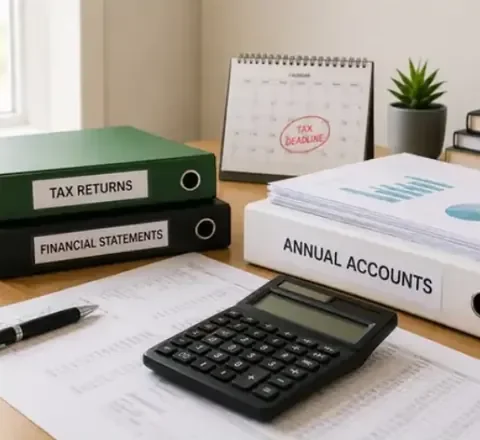
Year-end made simple
We prepare your annual financial statements and income tax returns accurately and explain the results in plain language.
Financial statements
Prepared to meet Inland Revenue requirements and, where needed, for your bank or other stakeholders.
Income tax returns
Returns for individuals, sole traders, partnerships, companies, look-through companies and trusts.
Extension of time
As your tax agent, we can usually file under an extension of time, giving more time than filing yourself.
Tax planning
We review your result before filing and talk you through provisional tax for the year ahead.
How we work with you
STEP 1
Initial call
We talk through your business by phone or video call and agree what you need.
STEP 2
Simple onboarding
We set up authority with Inland Revenue and access to your records or Xero.
STEP 3
We do the work
Bookkeeping, GST, payroll and year-end accounts are prepared accurately and on time.
STEP 4
Ongoing support
You get clear explanations, reminders before deadlines and help whenever questions come up.
We work with clients throughout New Zealand by phone, video call and email.
Common questions
When is my tax return due?
For a 31 March balance date, returns are generally due on 7 July. If you are linked to a tax agent with an extension of time, the due date is usually 31 March of the following year.
What do I need to provide?
Usually access to your Xero file or bank statements, plus details of assets bought or sold, loans and any other income. We send you a simple checklist.
Can you catch up returns from previous years?
Yes. We can prepare overdue returns and help you deal with Inland Revenue about any penalties.
This page provides general information only and is not advice for your particular situation. Tax rules can change. Last reviewed: October 2026.
Annual accounts and tax return deadlines
- Tax year: usually 1 April to 31 March.
- Without a tax agent: returns are due 7 July.
- With us as your tax agent: usually up to 31 March the following year, under Inland Revenue's extension of time.
- Provisional tax: generally applies if your end-of-year tax was more than $5,000.
Who we prepare annual accounts for
- Sole traders and individuals (IR3)
- Companies (IR4) and look-through companies (IR7)
- Partnerships (IR7)
- Trusts (IR6)
- Rental property owners (IR3R schedules)
Year-end checklist - what to send us
- Bank statements for all business accounts for the full year (or Xero access)
- Sales invoices and records of cash takings
- Expense receipts and supplier invoices
- Loan and hire purchase statements
- Details of assets bought or sold during the year
- Stock on hand at year end, if you hold stock
- Vehicle logbook and home office details, if you claim them
- Wages and payroll records, if you have staff
- Any letters from Inland Revenue
You can use our business tax return questionnaire to send everything in one go.
More common questions
Does my company need financial statements?
Under the Tax Administration (Financial Statements) Order 2014, most companies, including look-through companies, must prepare at least a balance sheet and profit and loss statement for tax, with accounting policies. Small companies that are not part of a group, with income and expenses each of $30,000 or less, and non-active companies are exempt.
What is provisional tax?
If the tax you had to pay at the end of the year was more than $5,000, you will generally have to pay provisional tax in instalments during the next year. We explain the options and dates for you.
Can you take over from my current accountant?
Yes. We request your records and link as your tax agent with Inland Revenue - you do not have to do the paperwork.
Do I need to meet you in person?
No. We work with clients all over New Zealand by phone, email, WhatsApp, Microsoft Teams and Google Meet.
Get your annual accounts done. Call 021 0234 6659, email ysm@yugrajca.co.nz, or book a call. We work with clients all over New Zealand, in English, Punjabi and Hindi.