
Your Truck Is Busy — But Is It Profitable?
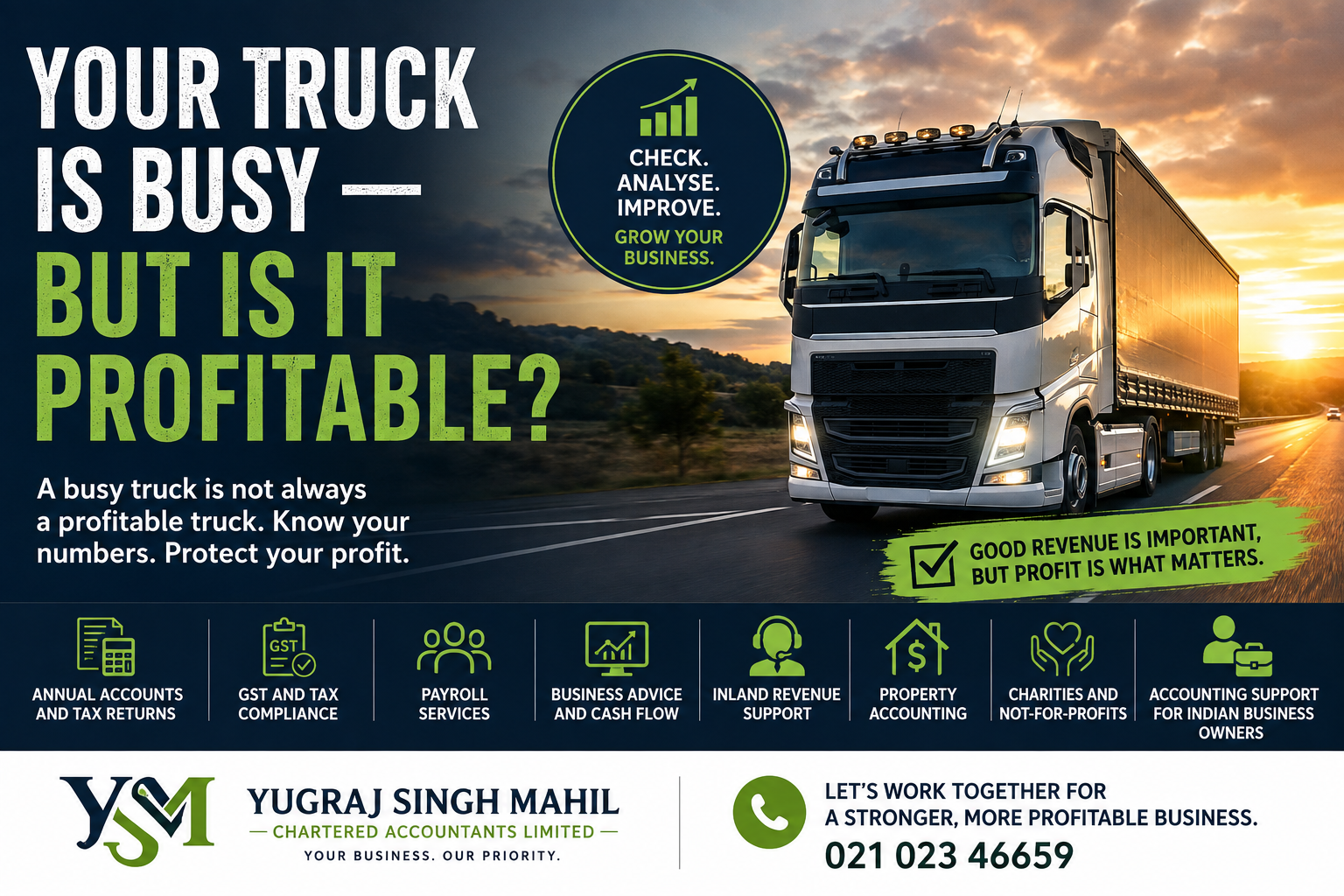
Truck on a New Zealand road with graphic text about understanding trucking business profitability and managing accounting costs.
By Yugraj Singh Mahil CA
A truck can be working every day and still make less profit than you think.
For a trucking business, turnover is important, but turnover does not tell the full story. The real question is what is left after fuel, RUC, wages, repairs, finance and other costs are paid.
If you have more than one truck, this becomes even more important. You need to know what each truck is actually contributing to the business.
Look at each truck on its own
If all trucks are grouped together, one profitable truck can hide another truck that is not performing well.
A better approach is to review each truck separately.
For each truck, look at:
revenue
fuel
RUC
wages
repairs and maintenance
insurance
finance costs
depreciation
downtime
This gives you a much clearer picture of which truck is making money and which one needs attention.
Payroll services: Owner-driver or employed driver
The cost structure can be very different depending on who drives the truck.
If you drive the truck yourself, you are not paying a separate driver wage to another person. Your own drawings or remuneration may also change depending on the cash flow and profitability of the business.
However, when you assess the real performance of the truck, it is still sensible to consider the value of your own time.
If you employ a driver, the wages must be paid even when the truck has a slow week or higher costs.
That means a truck with an employed driver may need a higher level of revenue to remain profitable.
Watch repair and maintenance costs
Repairs can make a big difference to the profit of a truck.
If one truck is costing much more to repair than the others, ask why.
The reason may be:
the age or condition of the truck
the route or road conditions
the type of work being done
poor preventative maintenance
a recurring mechanical problem
the way the truck is being driven
The important point is not just to record the repair bill.
You want to understand the cause.
If repair costs keep increasing, it may be time to consider whether the truck should be repaired, used differently, or eventually replaced.
Have a plan for sickness and driver shortages
Another cost that can easily be overlooked is downtime.
If you are an owner-driver and you get sick, who will drive the truck?
If your employee driver is away, do you have a relief driver available?
A truck can still have finance, insurance and other fixed costs even when it is sitting in the yard.
It is worth knowing:
whether a relief driver is available
what that driver will cost
how quickly they can start
how much income may be lost if the truck is off the road
This is part of understanding the real financial risk of each truck.
Watch what is happening to diesel prices
Truck owners also need to keep an eye on events outside New Zealand.
The 2026 Middle East conflict showed how quickly international events can affect oil and fuel prices.
For a trucking business, this matters because diesel is one of the major operating costs.
Your truck may be doing the same route and earning the same freight income, but if diesel becomes more expensive, your profit margin can fall.
So when fuel prices rise, do not only ask how much diesel has gone up.
Ask:
What has the increase done to the profit of each truck?
If fuel costs rise and your freight rate stays the same, the effect can be significant.
Business advice and cash flow: Monthly management reports for each truck
This is why monthly management reporting can be so useful for a trucking business.
You should not have to wait until the end of the financial year to find out that a truck has been underperforming.
A monthly report for each truck can help you see:
whether revenue is changing
whether fuel costs are increasing
whether repairs are getting too high
whether wages are taking too much of the margin
whether the truck is spending too much time off the road
whether the freight rate is still enough to cover the costs
If the numbers change, you can investigate the reason early.
That is much more useful than finding out many months later.
Business advice and cash flow: Profit and cash flow are different
A trucking business can make a profit but still have cash-flow problems.
Cash may also be needed for:
loan repayments
GST
PAYE
provisional tax
income tax
repairs
replacement equipment
suppliers
owner drawings
customers who have not paid yet
That is why you need to watch both profit and cash flow.
If you do not monitor them regularly, the first sign of trouble may be when GST, PAYE or income tax becomes difficult to pay.
By that stage, the business may already be under financial pressure.
GST and tax compliance: Do not wait until tax becomes a problem
If GST, PAYE or income tax is becoming difficult to pay, it is better to deal with the issue early.
A business can stay busy while margins are getting smaller.
Higher fuel costs, wages, repairs and finance costs can reduce the cash available for tax payments.
Regular reporting can help you see this before the problem becomes serious.
Inland Revenue support: If you are getting behind with tax
If you are struggling to pay GST, PAYE or income tax, do not ignore it.
Speak with your accountant and contact Inland Revenue early.
Understanding the problem and dealing with it early is usually better than waiting until arrears continue to grow.
Before buying another truck
Buying another truck can increase your turnover, but it will also increase your costs.
Before signing a finance agreement, work through the numbers.
Consider:
expected freight income
driver wages
fuel
RUC
finance
insurance
repairs
downtime
compliance costs
relief driver costs if required
Also consider what could happen if fuel prices rise again or the truck is not fully utilised.
The important question is not only:
Can I get finance for another truck?
The better question is:
Will this truck make a reasonable return after all the costs are paid?
Annual accounts and tax returns are only part of the picture
Annual accounts and tax returns are important, but they tell you what has already happened.
For a trucking business, monthly figures can be just as important.
They can help you understand what is happening now and whether action may be needed before the end of the financial year.
Accounting support for Indian business owners
Many Indian truck owners and owner-drivers in New Zealand are running strong businesses, but accounting and tax information can sometimes be difficult to understand when English is a second language.
Good accounting support should be clear and practical.
The aim should be to explain the numbers in simple language so you understand:
what each truck is earning
where your money is going
whether your cash flow is healthy
what tax payments are coming up
whether one truck is costing more than it should
whether your business can afford another truck
You should be able to understand your accounts and use them to make better business decisions.
Final thought
A busy truck is not always a profitable truck.
For a trucking business, good financial management means understanding what each truck is earning, what it is costing, and why the profit may be changing.
If you operate several trucks, reviewing each truck separately can help you identify problems earlier and make better business decisions.
Good accounting should not only tell you what happened last year.
It should help you understand what is happening in your business now.
Yugraj Singh Mahil CA
Yugraj Singh Mahil Chartered Accountants Limited
www.yugrajca.co.nz
Phone: 021 023 46659
Important information
This article is for general information only. It is not personalised accounting, tax, financial, legal or investment advice. Every trucking business is different. You should obtain professional advice based on your own circumstances before making important business, financial or tax decisions.
